
How to prevent damage to my warehouse racking?
Why TRI is not a formality, it is operational continuity
Many incidents start small. A mark on an upright, a beam hit by a fork, a missing protector, a spacer removed after a modification. The problem is that the warehouse does not stop to warn you. The installation keeps working, accumulating stress, and the risk grows in silence until one day a blockage appears—the immobilization of a level, a reduction in capacity, urgent relocations, or safety shutdowns.
TRI breaks that chain with a methodology. It is not just about looking; it is about interpreting. The damage is identified, its criticality is evaluated, the probable cause is understood, and a concrete action is proposed: protect, repair with certified spare parts, reconfigure a maneuver point, correct a loading habit, or, if necessary, immobilize and validate before continuing operations.
What gets damaged most in industrial racking (and why it always happens in the same place)
Damage is not distributed uniformly. It concentrates where there is traffic, turns, braking, peak-hour replenishment, and aisles with compromised visibility. When the environment is demanding, locations are “forced,” maneuvers are tightened, and the impact eventually hits the structure.
Therefore, a useful technical inspection is not limited to pointing out a damaged upright; it asks what is happening around it: if the aisle is too narrow for the handling equipment, if the staging area invades the circulation path, if the rack ends are unprotected, or if there are flow changes that the layout has not yet absorbed.
What does a technical racking inspection review?
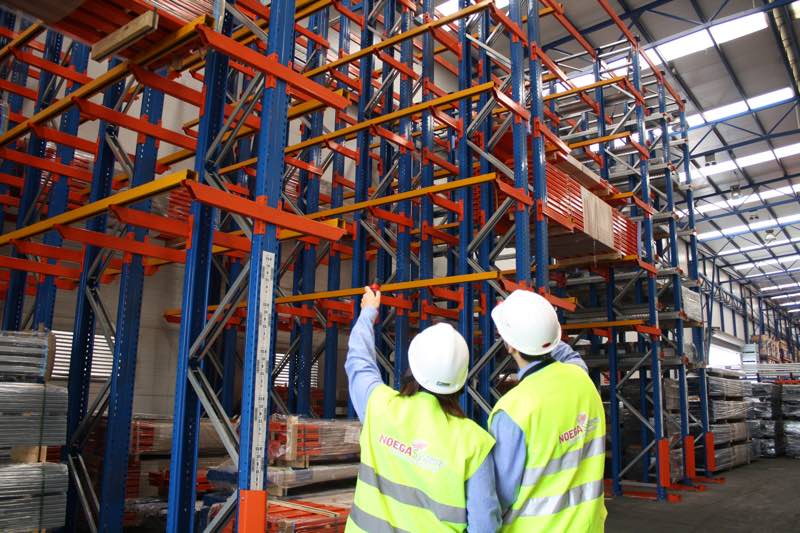
A TRI reviews load-bearing and safety elements and contrasts actual use with what the system can and must do. Frames, uprights, diagonals, beams, anchors, safety pins, and protectors are inspected. Operations are also observed: non-standard pallets, poorly distributed loads, aisle encroachment, forced levels, insufficient signage, and areas where impacts are recurring.
The goal is to transform findings into an actionable plan. Not just what is wrong, but what to do first, what can wait, what requires a certified spare part, what must be immobilized, and how to document it so that the warehouse does not rely on memory or interpretations.
Certified protectors and spare parts to prevent impacts from reaching structural elements
In industrial storage, “fixing” is not improvising. Changing a component without real compatibility can alter tolerances, structural behavior, or capacity. Therefore, certified spare parts and clear technical criteria are an investment in continuity—defining what is replaced, when use is limited, how the repair is validated, and how a documentary trace of the change is left.
With protections, the logic is direct: they pay for themselves where hits occur most frequently. Protecting rack ends and uprights in maneuver zones usually prevents repetitive damage, reduces replacements, and lowers the risk of incidents that force a warehouse reorganization against the clock.
View this post on Instagram
Mobile and high-density racking: more capacity, more need for discipline and control
Mobile pallet racking is a high-density solution that allows for increased capacity without losing direct access to each pallet. The structures are installed on motorized mobile bases that move on rails, opening only the necessary working aisle at any given time. This optimizes volume and can provide significant savings in cold storage by reducing the volume of air to be cooled.
Precisely because of this density, TRI and usage control are even more critical. Operations are concentrated, access points become more sensitive, and any deviation from habits is amplified. Signage, safety devices, placement discipline, and state reviews at entry points make the difference between a robust system and one that accumulates incidents.
Critical points table and recommended measures
This table serves as a practical guide to detect where damage accumulates and which measures typically work best. On mobile devices, you can swipe horizontally.
| Critical Point | What usually happens | Warning Sign | Recommended Measure | Benefit | When to review |
|---|---|---|---|---|---|
| Aisle entrance / rack ends | Hits from turns, braking, and cross traffic | Repeated marks, missing or deformed protection | Rack end protection + signage + visibility improvement | Fewer recurring damages and fewer stops | After activity peaks or flow changes |
| Uprights in maneuver zones | Side impact during rushed maneuvers | Deformation, loss of verticality, chipped paint in the hit zone | Upright protection + maneuver adjustment + staging order | Prevents deformations and replacements | Monthly internal rounds + periodic TRI |
| Beams and load levels | Hits from forks, forced supports, non-standard pallets | Dents, looseness, missing safety pins | Review of loading habits + certified spare part if necessary | Sustained real capacity and less rework | After incidents or pallet type changes |
| Staging / consolidation zones | Pallets out of place, aisle encroachment | Blockages, avoidance maneuvers, congestion | Physical delimitation + order rules + traffic routes | More fluidity and fewer hits from congestion | When bottlenecks appear |
| Aisle ends | Collisions due to direction changes and blind spots | Repeated hits, marked protections | Protections + mirrors/warnings + speed limits | Reduction of scares and structural damage | When internal traffic increases |
| Mobile systems (high density) | Maneuver concentration and wear at access points | Repeated incidents at entries, use outside criteria | Safety device review + operational discipline + signage | High capacity with safety and continuity | After expansions or shift/team changes |
Continuous improvement plan: simple, constant, and with traceability
Technical inspection works best when it doesn’t just stay on a document. The goal is to create a stable cycle: detect early, prioritize with criteria, correct with appropriate measures, form habits, and verify. When documented, the warehouse stops depending on memory or improvisation and gains consistency.
A useful method typically includes internal rounds, photographic records, classification by criticality, actions with a responsible party and date, and a subsequent verification to confirm that the risk has been reduced and that the cause is not repeated.
Frequently Asked Questions
How often should a technical racking inspection be performed?
When does damage go from being aesthetic to being a risk?
Which protections usually pay for themselves first?
Why is it important to use certified spare parts?
Is there anything special to check in mobile racking?
What should an action plan include after a TRI?
At ITE we perform technical racking inspections, define action plans, supply certified protections and spare parts, and train your team to reduce incidents and sustain safer industrial storage. Contact us.